Benefits of dips: what they train, how often and a simple push plan
Benefits of dips: triceps, chest and shoulder push strength at home or the gym. Sets, reps, how often each week, and a two-day plan with safer options.
revns editorial · Published November 22, 2026 · 10 min read

Dips are a compound push for triceps, chest and shoulders. Do them 2–3 times a week, 2–4 sets of 6–12 reps, with shoulder-safe depth; progress with bands or weight.
The main benefits of dips are stronger triceps, chest and front-shoulder pushing, better bodyweight control, and balance with pulling work like rows and pull-ups. Dips are a compound push, not a full workout. Most adults do well with two or three dip sessions a week, two to four sets of 6 to 12 reps, and depth that stays pain-free at the shoulder. Start with bench dips or a band if full parallel-bar dips are too hard.
TL;DR
| Question | Short answer |
|---|---|
| What do dips train? | Triceps, chest (pectoralis major), front shoulders, core brace |
| Why do them? | Push strength, calisthenics progress, pairs with pull-ups |
| How often? | 2–3 days a week, 48–72 h between hard push days |
| Sets and reps | 2–4 × 6–12, stopping 1–3 reps before form breaks |
| Easier start | Bench dips, band-assisted dips, negative-only reps |
| Who should modify? | Front-shoulder or sternum pain: shorten range or see a clinician |

What muscles do dips work?
Dips are a vertical or near-vertical push: you support your body on parallel bars or the edge of a bench, bend the elbows to lower, then press back to straight arms. The triceps brachii extend the elbow. The pectoralis major (especially the sternal head) and anterior deltoid help press and stabilize. The core and scapular muscles work isometrically to stop your torso from swinging.
Leaning changes the emphasis without changing the exercise name. Upright dips with elbows tucked tend to feel more triceps-heavy. A slight forward lean and elbows flaring a little often feel more chest-heavy, within a range that still feels stable at the front of the shoulder. Your anatomy and grip width matter as much as the lean angle.
This is different from hip dips, a cosmetic term for the indentation below the hip bone. Training dips does not target that shape; it trains push muscles.
What are the benefits of dips?
Stronger pushing for sport and daily life
Any movement that pushes your body or a load away uses the same muscle groups dips train: getting up from the floor, pushing doors, pressing luggage overhead, or finishing a set of push-ups. When dips feel easy for controlled reps, push-ups and presses often progress because the triceps and chest are less likely to fail first.
Efficient upper-body volume with little equipment
Parallel bars at a park, dip handles in a gym, or a sturdy bench at home can cover a full push stimulus. That matters when you travel or train in a small space. Dips sit well in calisthenics for beginners after you can hold a solid plank and do several clean push-ups.
Balance with pull-ups and rows
Many programmes are pull-heavy (rows, lat work) but light on direct push volume. Dips and pull-ups together cover the upper body's main vertical patterns. You do not need both on the same day, but a week that includes pulls and dips tends to feel more even across the front and back of the torso.
Bone and muscle guidelines for adults
The WHO recommends that adults do muscle-strengthening activities on two or more days per week that work major muscle groups. Dips count toward that tally when they are part of a balanced week that also trains legs, back and core. They are not a substitute for leg work or rest days.
Triceps size and lockout strength
If lockout fails on bench press or overhead work, triceps are often the limiter. Dips load the triceps through a long range at bodyweight or added load. Tricep extensions isolate the elbow; dips integrate the triceps with shoulder and chest stabilizers. Many lifters use both; neither alone is mandatory.
Benefits of dips compared with push-ups
Push-ups and dips both train push muscles, but dips usually load the triceps and chest more per rep because your feet leave the ground and shoulder extension can go deeper. Push-ups are easier to scale for beginners and are gentler on some shoulders because the feet stay on the floor.
| Feature | Push-ups | Parallel-bar dips |
|---|---|---|
| Equipment | Floor or mat | Bars or station |
| Load progression | Incline, then floor, then feet elevated | Band assist → bodyweight → weighted |
| Shoulder demand | Moderate; feet share load | Higher; full bodyweight on arms |
| Best early step | Incline push-ups | Bench dips |
A 2017 trial in the Journal of Exercise Science and Fitness (Kikuchi and Nakazato) randomised 18 untrained young men to bench press at 40% of one-rep max or load-matched push-ups for 8 weeks (3 sets to failure, twice weekly) and found similar chest and triceps thickness gains on ultrasound. That does not compare dips directly, and the sample was small and all male, but it supports the idea that bodyweight push work can build upper-body muscle when sets are hard and progressive. Dips belong in that same push family once shoulders tolerate the depth.
Benefits of dips and pull-ups together
Pull-ups emphasize lats, biceps and grip; dips emphasize triceps, chest and front shoulders. Rotating them across the week is a simple split:
| Day type | Example focus |
|---|---|
| Pull emphasis | Rows, pull-ups, face pulls |
| Push emphasis | Push-ups, dips, overhead press |
| Full body | One pull move + one push move + legs |
You do not need maximal dips and maximal pull-ups the same session. One hard set of each after compounds is enough for many beginners.
How often should you do dips?
Two or three times a week fits most people who already train. That aligns with how much exercise per week from WHO guidance. Hard dip days should sit at least 48 hours before the next heavy push or dip day unless you keep load very light.
| Weekly schedule | Who it suits |
|---|---|
| 2 dip days | Full-body 3×/week, busy schedules |
| 3 dip days | Push-pull-legs or upper-lower splits |
| Daily dips | Avoid heavy daily loading; technique or rehab only |
Signs you are doing too much: front-shoulder ache that worsens each session, elbow tendon irritation, shrinking reps at the same depth for two weeks, or dips replacing leg and pull work. Swap a dip day for active recovery.
Is it OK to do dips every day?
Daily heavy dips are not necessary and often stall progress. Muscle recovery for the same movement pattern still needs 48 to 72 hours for most adults. If you like moving every day, use bench dips or band-assisted reps on easy days and save full depth for two or three sessions.
How many sets and reps of dips?
For strength and size in novices, 2 to 4 sets of 6 to 12 repetitions, stopping 1 to 3 reps before form breaks, matches ranges the American College of Sports Medicine often cites for learning resistance training. Advanced lifters sometimes use lower reps with added weight; beginners should prioritize clean depth and shoulder comfort over load.
| Goal | Sets × reps | Rest | Notes |
|---|---|---|---|
| Learn the pattern | 3 × 6–8 assisted | 90–120 s | Band or bench dips |
| General strength | 3 × 6–10 | 90–120 s | Pause at the bottom if shoulders allow |
| Muscle and endurance | 2–3 × 8–12 | 60–90 s | Stop before shoulder pain |
| Weighted dips | 3–4 × 4–8 | 2–3 min | Only after pain-free bodyweight |
Across the week, roughly 6 to 12 direct triceps sets from dips plus pressing often sit in the range meta-analyses of resistance training discuss for hypertrophy when other work is balanced. A 2017 meta-regression in the Journal of Sports Sciences (Schoenfeld, Ogborn and Krieger; 15 studies, 34 treatment groups) found a graded dose-response: each extra weekly set linked to slightly greater muscle-size gains, with higher versus lower volume within the same trial about 3.9% larger on average. That does not mean endless sets; recovery still caps useful volume. You do not need extreme dip volume if presses and rows already add sets.
When to add load: when you can do the top of your rep range for all sets with the same controlled tempo and no shoulder pinch, add a small weight (dip belt or light dumbbell between feet) or add one rep per set before loading.
How to do dips with good form
- Grip the bars, arms straight, shoulders down and back (not shrugged toward ears).
- Cross the ankles or keep legs slightly forward for stability.
- Lower until elbows reach about 90 degrees or the deepest pain-free range for your shoulders.
- Press up until elbows lock softly without bouncing at the top.
- Keep the torso still; do not kip with the legs.
Common mistake: dropping so deep the front shoulder pinches or the sternum hurts. The fix is a shorter range, bench dips, or band assistance.
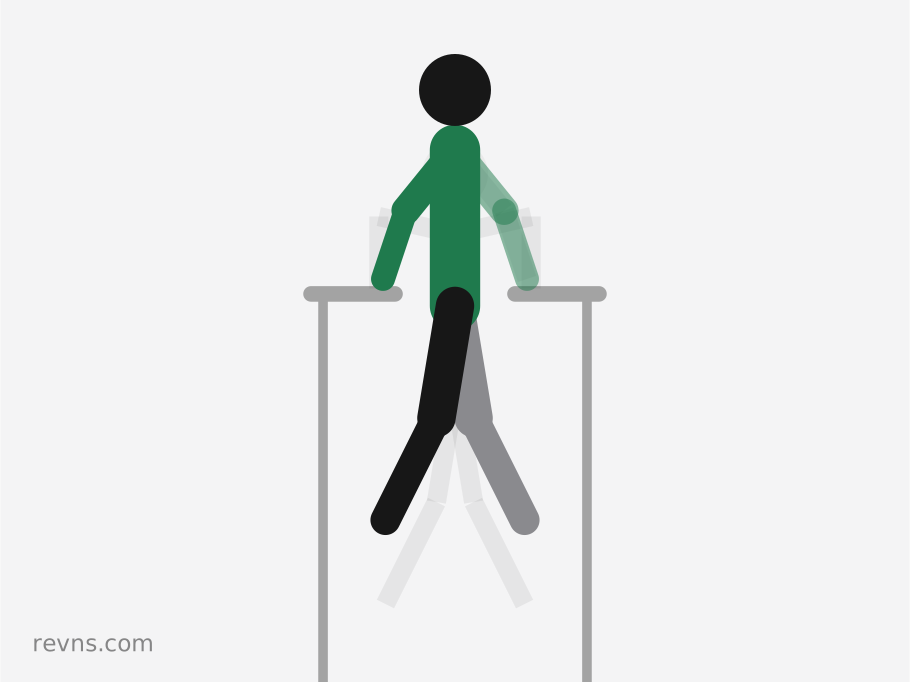
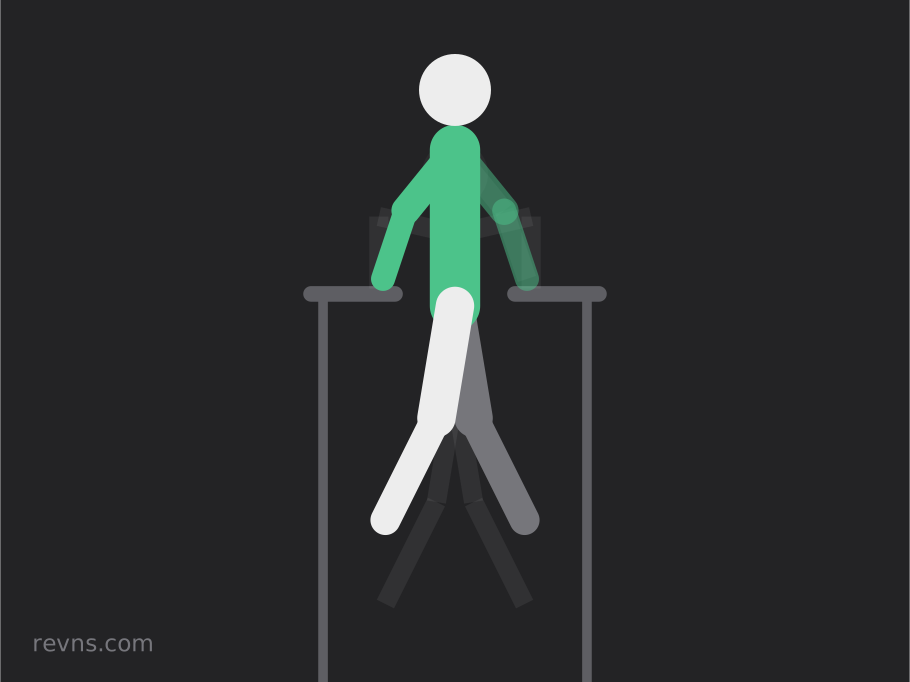
Easier: bench dips, band-assisted dips on a station, or slow negatives with a jump assist at the bottom. Harder: weighted dips, ring dips (advanced; more shoulder stability demand). Similar: diamond push-ups, close-grip push-ups.
A simple dip workout plan (two days a week)
Use dips after main compounds, not instead of leg work. Each arm block takes 10 to 15 minutes.
Day A (push or upper day)
| Exercise | Sets × reps | Rest |
|---|---|---|
| Dips (or bench dips) | 3 × 6–10 | 90 s |
| Push-ups | 2 × 8–12 | 60 s |
Day B (push or full body, 2–3 days later)
| Exercise | Sets × reps | Rest |
|---|---|---|
| Band-assisted or bench dips | 3 × 8–12 | 60 s |
| Overhead press or pike push-up | 2 × 8–10 | 90 s |
Warm up: two sets of scapular push-ups or band pull-aparts, then one easy set of 5 dips or bench dips. See how to warm up before a workout.
Track progress: log reps, assist level and whether shoulders felt pinchy. Use a workout log or simple workout tracker so load trends stay visible next to sleep and resting heart rate if you wear a watch.
Benefits of dips for men and women
Men and women gain the same functional benefits: stronger lockout, better push-up performance, and support for strength training for women or men’s upper-body programmes. Hormones and genetics set how fast muscle grows; dips alone will not create large arms without months of progressive overload, enough protein and overall volume.
Women with lighter relative upper-body strength often start with bench dips or bands and build toward full dips over weeks to months, not days. Men recovering from shoulder issues may need the same regression despite higher starting strength.
Dips vs tricep extensions: which should you pick?
| Tool | Best when |
|---|---|
| Dips | You want compound push strength, have stable shoulders, and like bodyweight progressions |
| Tricep extensions | You want isolated triceps work with lighter joint stress or home dumbbells only |
| Both | Pressing stalls at lockout and you recover well between push days |
What to do this week
- Test 3 sets of bench dips or band-assisted dips. Stop with two reps left in the tank.
- If shoulders stay comfortable, try one set of full dips after push-ups on your next upper day.
- Log depth, reps and shoulder feel for four weeks before you judge strength gains.
- Keep one full rest or easy day between hard push sessions.
- If front-shoulder pain lasts more than a week, shorten range and get assessment if pain is sharp.
When to see a professional
Stop and get medical advice for sharp front-shoulder or sternum pain, elbow swelling or constant ache, numbness or tingling in the hand during dips, a popping shoulder with weakness, or pain that does not improve after a lighter week. This is general training guidance, not medical advice. Dips are not a treatment for impingement, labral tears or elbow tendonitis.
Shoulder pain is common when people increase dip depth or volume too fast. A 2010 narrative review in the Journal of Strength and Conditioning Research (Kolber and colleagues) summarised epidemiological reports and noted that up to 36% of documented resistance-training injuries and disorders involve the shoulder complex—not a dip-specific rate, and much of the underlying data are retrospective surveys. Separate questionnaire work on recreational weight trainers has found shoulder pain during training is common when form or exercise selection loads the joint awkwardly. That is a reminder to progress range and load slowly and to stop when pain is local and persistent.

Related
- Benefits of bicep curls: what they train, how often and a simple plan
- Benefits of overhead press: what they train and a simple plan
- Tricep extensions workout plan: benefits and a weekly routine
- Calisthenics for beginners: push-up to pull-up progressions
- Strength training for beginners: a simple plan for the first eight weeks
- How long to rest between sets: strength, muscle and endurance
- Dips exercise library page
This is general training guidance, not medical advice.
Sources
- Bull FC et al. WHO Guidelines on Physical Activity and Sedentary Behaviour. Br J Sports Med 2020.
- American College of Sports Medicine. ACSM's Guidelines for Exercise Testing and Prescription, 11th ed. Wolters Kluwer.
- Kikuchi N, Nakazato K. Low-load bench press and push-up induce similar muscle hypertrophy and strength gain. J Exerc Sci Fit 2017.
- Schoenfeld BJ, Ogborn D, Krieger JW. Dose-response relationship between weekly resistance training volume and increases in muscle mass: a systematic review and meta-analysis. J Sports Sci 2017.
- Kolber MJ et al. Shoulder injuries attributed to resistance training: a brief review. J Strength Cond Res 2010.
Terms in this post
revns publishes training and nutrition guidance, not medical advice. See a clinician for symptoms, injury or a medical condition. Accurate as of November 22, 2026.