Rest days: how many you need and what to do on them
How many rest days a week do you need? A plain guide for lifters, runners and walkers: what counts as rest, easy-day options, warning signs and a weekly plan.
revns editorial · Published November 13, 2026 · 11 min read
No guideline sets a magic number of rest days. Most regular exercisers do well with one to three rest or easy days a week; adjust by load, sleep and how sessions feel over two weeks.
Most adults who train regularly do well with one to three rest or easy days a week, but no guideline sets one number. The right amount depends on how hard you train, how well you sleep, how much stress you carry and how new the training is. A good rule is to plan at least one full rest day, keep hard sessions apart and let how you feel over two weeks, not one morning, decide whether you need more.
TL;DR
| Question | Short answer |
|---|---|
| How many rest days a week? | At least one full rest day; many people do better with two to three rest or easy days |
| Does rest mean doing nothing? | No. Easy walking and mobility count as active recovery |
| Will one day off cost me progress? | No. Fitness and strength change over weeks |
| How do I know I need more? | Sessions feel harder at the same load, sleep is poor and mood is low for 7 to 14 days |
| When is it not about rest? | Chest pain, fainting, low mood for 2+ weeks: see a clinician |
What is a rest day, really?
A rest day is a day with no planned training stress. You skip the session that would leave you sore, breathless or mentally drained. You do not have to lie on the sofa. Everyday movement such as walking to the shop, cooking or playing with children still counts as normal life, and public health guidance encourages it.
It helps to separate three kinds of day:
- Hard day: a session that you expect to feel in the next day or two, such as heavy lifting near your limit, intervals or a long run.
- Easy day: light movement that does not add meaningful fatigue, such as a relaxed walk, easy cycling, gentle swimming or a mobility routine.
- Full rest day: no planned exercise. Sleep, food and unhurried time are the plan.
Calling all three "a rest day" is where confusion starts. A gentle 30-minute walk after a leg session is a recovery tool. A 60-minute "light" run at a pace that leaves you out of breath is a hard session wearing a disguise.
Why do you need rest days at all?
Training is a stress, and the body adapts to it afterwards. Muscles repair, energy stores refill and the nervous system settles during recovery, not during the session itself. Without enough recovery, the stress builds up faster than the body can absorb it.
Sports medicine bodies describe this as a spectrum. In the 2013 joint consensus statement from the European College of Sport Science and the American College of Sports Medicine, Meeusen and colleagues separate short-term functional overreaching (a hard block followed by better performance after rest) from non-functional overreaching and overtraining syndrome, where performance stays down and fatigue, sleep and mood problems last for weeks or months. The statement also notes that diagnosis is hard and that medical causes must be ruled out. Most people never reach the far end of that spectrum, but feeling flat and stale after a hard stretch is a common, milder form of the same pattern.
A 2018 consensus statement on recovery in sport by Kellmann and colleagues in the International Journal of Sports Physiology and Performance makes a related point: responses to training and to recovery strategies vary from person to person, and the balance between stress (training and other life demands) and recovery is what matters. Two people on the same programme can need different amounts. That is why a fixed "rest every third day" rule fits some people and fails others.
A 2016 International Olympic Committee consensus in the British Journal of Sports Medicine (Soligard and colleagues) adds the injury angle. It reports that poor load management, including rapid changes in training load, is a major risk factor for injury in athletes. Rest days are one way to keep load from spiking. They work best alongside a gradual build, not as a reaction after you are already hurt.
How many rest days per week do you need?
No major guideline gives a number of rest days. What the WHO 2020 guidelines on physical activity and sedentary behaviour (Bull and colleagues, British Journal of Sports Medicine) do give is a weekly amount to aim for:
- 150 to 300 minutes of moderate-intensity activity a week, or 75 to 150 minutes of vigorous activity, or an equal mix, for adults.
- Muscle-strengthening activity on two or more days a week.
- The message that any activity is better than none.
Those targets are well within reach with rest days built in. The WHO fact sheet on physical activity, updated 4 November 2026, still reports that 31% of adults worldwide, about 1.8 billion people, do not reach the 150-minute minimum. For most readers the larger risk is doing too little, not too much. Rest days are for people who are already training, so that they can keep training.
Here is a practical range, not a rule:
| Your situation | Typical pattern |
|---|---|
| New to training, 2 to 3 sessions a week | 4 to 5 non-training days; walking on some of them |
| Regular lifter, 3 to 4 sessions | 1 full rest day plus 2 easy or off days |
| Runner, 4 to 5 runs | 1 full rest day; keep only 1 or 2 runs hard |
| Hybrid athlete or Hyrox, 5 to 6 sessions | 1 full rest day; at least 2 sessions easy; plan a lighter week every 4 to 8 weeks |
| Poor sleep, illness or high work stress | Add rest or easy days; cut hard sessions first |
| Over 50, or returning after a break | Often 2 or more rest days between hard sessions for the same muscle groups |
Muscle-strengthening is the one area where the spacing has some evidence. A 2016 meta-analysis by Schoenfeld and colleagues in Sports Medicine (ten trials) concluded that training each muscle group twice a week gave better muscle growth than once a week when volume was matched. A 2018 meta-analysis by Grgic and colleagues (22 studies, mostly in untrained people) looked at strength gains and found no significant effect of frequency once weekly volume was equal. Read together: you can spread your sets across more days or fewer, and what matters most is the total weekly work you can recover from. Neither paper says you need to train the same muscle on back-to-back days.
What should you do on a rest day?
Pick what helps you feel ready for the next session. Good options:
- A relaxed walk of 20 to 40 minutes. Keep the pace easy enough to talk in full sentences.
- Mobility or gentle yoga for 10 to 20 minutes, if it feels good. Stretching is optional, not a recovery requirement.
- Easy cycling or swimming at a pace you could keep up for an hour.
- Sleep first. Use the sleep calculator to set a bed window, and read the guide on how much sleep you need.
- Meals that cover your needs. Under-eating on a rest day stacks fatigue onto fatigue. Vegetarian, vegan, eggetarian, Jain and non-vegetarian meals all work. Use the protein guide to check your day.
- Planning: look at the coming week, mark hard and easy days and book the sessions.
And a few things to avoid: turning the day into a "make-up" workout for a session you missed, grinding through a hard session because you feel guilty and taking up a new activity you are not used to. Novelty adds muscle soreness and injury risk.
Does active recovery work better than complete rest?
The evidence is mixed. Studies on light exercise after hard sessions often find small, short-lived benefits to how sore people feel, but the effects are small and differ by method. The practical takeaway: if an easy walk or spin makes you feel better, do it. If you feel better sitting still, that is also fine. Neither choice has been shown to cost you progress.
What does matter is that "active" stays easy. A good test is the talk test from zone 2 training: if you cannot speak in full sentences, it is no longer recovery. The heart rate zone calculator gives a rough ceiling if you prefer numbers.
How do you know you need more rest?
Look at trends over 7 to 14 days, not one bad morning. Signs that you may need extra rest or a lighter week:
- Weights or paces that used to feel routine now feel heavy, with no change in your programme.
- Resting heart rate several beats above your usual baseline for a week. See the guide to heart rate variability for how to read these numbers without over-reading them.
- Sleep that is short or broken, or sleep debt that weekend lie-ins do not clear.
- Low mood, irritability or loss of interest in training you usually enjoy.
- Aches in tendons or joints that do not settle between sessions.
A 2016 systematic review of 56 studies by Saw and colleagues in the British Journal of Sports Medicine of athletes found that subjective self-reported measures (such as mood and perceived stress) reflected training load with better sensitivity and consistency than objective measures such as heart rate or blood markers. A short daily log is a sound tool. The guide to tracking mood and energy next to training shows what to write down, and the stress, burnout and deload guide covers what to do when the signs add up. A planned deload week, with roughly half the usual volume, is a bigger version of the rest day.
Wearable recovery scores can add one more data point, but treat them as a nudge. The guide to Whoop, Oura and free trackers explains what those scores do and do not measure. Device sync from Apple Health, Strava and Garmin is on the revns roadmap and is not live.
Can you train hard on back-to-back days?
Yes, with limits. Many programmes split work by muscle group (upper body, then lower body) or by type (a hard run, then an easy spin). That lets one system recover while another works. Problems appear when two hard days load the same tissues, such as two long runs or two heavy squat sessions in a row, or when three or more hard days follow each other.
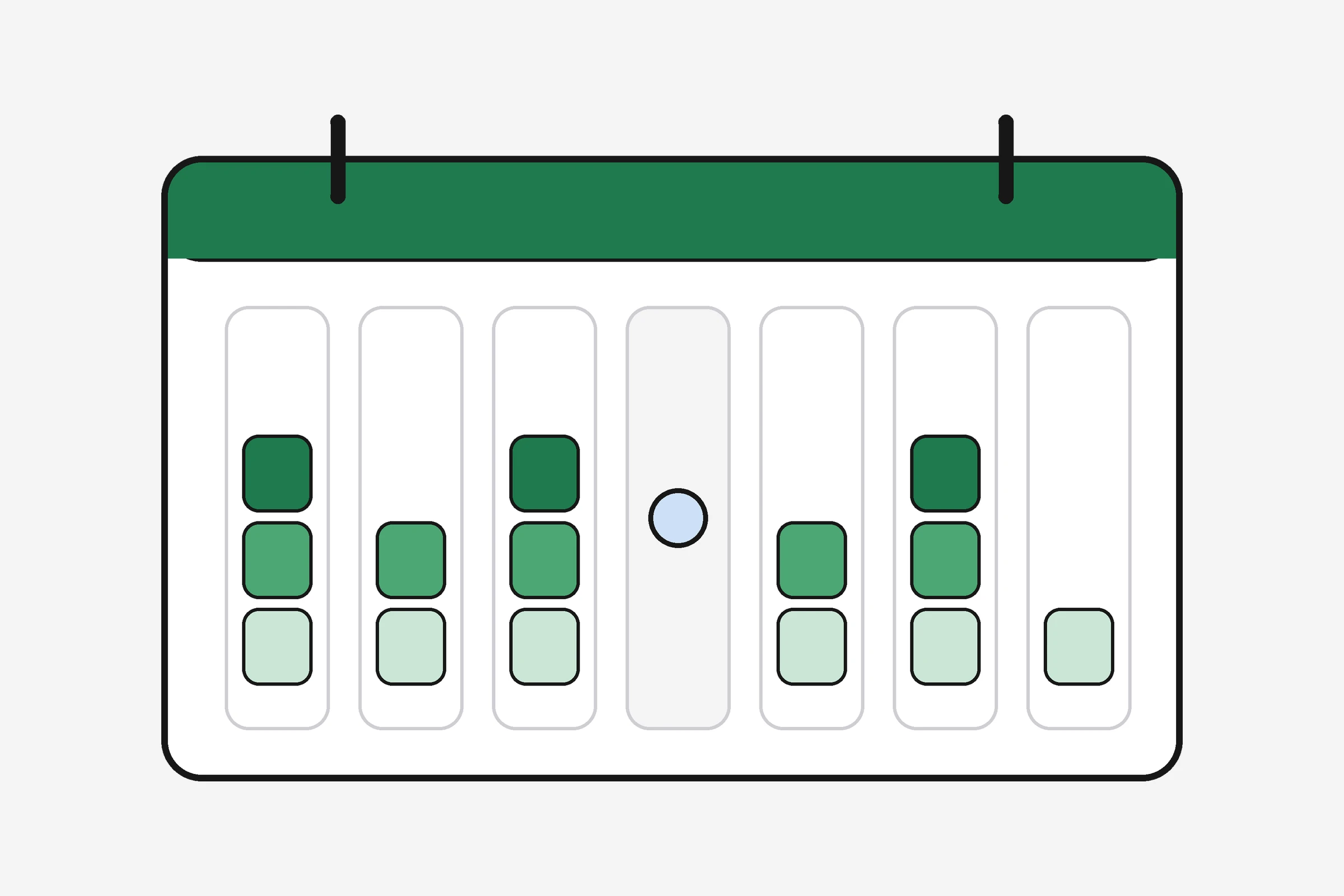
A simple weekly shape that works for many people:
| Day | Example |
|---|---|
| Mon | Strength, lower body (hard) |
| Tue | Easy walk or off |
| Wed | Strength, upper body (moderate) |
| Thu | Easy aerobic session or off |
| Fri | Intervals or a long strength session (hard) |
| Sat | Easy long walk or cycle |
| Sun | Full rest |
Swap days to fit your life. The pattern to keep is that no more than two hard days sit together and that each week holds at least one day with no planned training. The AI fitness coach in revns builds the week the same way: it avoids three hard days in a row and can set a moderate day when sleep is below your floor. The multi-sport tracker lets you log a run, a ride and a lift in one week so you can see the whole load.
What should you do this week?
If you are new to training
- Pick two or three days for strength work and keep at least one rest day between sessions. The beginner strength guide has a first eight-week plan.
- Walk on one or two of the other days, easy and unhurried.
- Keep one day fully free, and do not feel guilty about it.
If you already train four or more days a week
- Mark each session hard, moderate or easy. Count the hard ones. If there are more than three, change one to easy.
- Make sure one day a week has no planned training.
- Log mood, energy, sleep and how hard each session felt for two weeks. If these slide for more than five days, take the next hard session down a level, or plan a lighter week.
- Use the five numbers weekly check-in to review the week in a few minutes.
If you train through a busy season at work
- Treat sleep as a training session: set a bed window and keep it.
- Swap one hard session for an easy walk.
- Keep your weekly total honest. A smaller plan done well beats a big plan you skip.
When should you see a professional?
Rest does not fix every kind of tiredness. See a doctor or another qualified clinician if you notice:
- Chest pain, fainting, a racing or irregular heartbeat, or unusual breathlessness during or after exercise. Stop and get assessed before you train hard again.
- Pain that is sharp, in a joint, getting worse or waking you at night, or any injury that does not improve in a week or two.
- Tiredness that does not lift after one to two weeks of lighter training and good sleep, especially with weight loss you did not plan, fever or frequent illness.
- Low mood, hopelessness or loss of interest most days for more than two weeks, or anxiety that stops you working or sleeping.
- Missed or absent periods, or repeated stress injuries, which can signal that energy intake is too low for your training load.
If you feel unsafe or might harm yourself, contact your local emergency number or a crisis line now. In the US you can call or text 988. In the UK and Ireland, Samaritans are on 116 123. In India, KIRAN is on 1800-599-0019. You can find other countries at findahelpline.com.
Related
- Stress, burnout and when to deload
- Sleep debt: can you catch up on weekends?
- What is HRV? Heart rate variability explained
- Strength training for beginners
- Zone 2 training explained
- AI fitness coach and week planner
- Sleep calculator
This is general training guidance, not medical advice.
Sources
- Bull FC et al. World Health Organization 2020 guidelines on physical activity and sedentary behaviour. Br J Sports Med 2020
- World Health Organization. Physical activity fact sheet, updated 4 November 2026
- Meeusen R et al. Prevention, diagnosis and treatment of the overtraining syndrome: joint consensus statement of the ECSS and ACSM. Eur J Sport Sci 2013
- Kellmann M et al. Recovery and performance in sport: consensus statement. Int J Sports Physiol Perform 2018
- Soligard T et al. How much is too much? (Part 1) International Olympic Committee consensus statement on load in sport and risk of injury. Br J Sports Med 2016
- Saw AE, Main LC, Gastin PB. Monitoring the athlete training response: subjective self-reported measures trump commonly used objective measures. Br J Sports Med 2016
- Schoenfeld BJ, Ogborn D, Krieger JW. Effects of resistance training frequency on measures of muscle hypertrophy: a systematic review and meta-analysis. Sports Med 2016
- Grgic J et al. Effect of resistance training frequency on gains in muscular strength: a systematic review and meta-analysis. Sports Med 2018
Terms in this post
revns publishes training and nutrition guidance, not medical advice. See a clinician for symptoms, injury or a medical condition. Accurate as of November 13, 2026.