Benefits of battle ropes: what they train, how often and a simple interval plan
Benefits of battle ropes: shoulder and grip endurance, core brace, and high metabolic demand in short intervals. Muscles worked, how often, and a beginner plan.
revns editorial · Published November 23, 2026 · 8 min read

Battle ropes build shoulder and grip endurance, core stability and cardio in timed intervals. Do them 1–3 days a week, 6–10 rounds of 20–30 seconds, with full rest between hard sets.
The main benefits of battle ropes are high-intensity upper-body conditioning, shoulder and grip endurance, core bracing, and a fast heart-rate rise without jumping. They suit 20- to 30-second interval waves with full rest between hard rounds. Most adults do well with one to three rope sessions a week, 6 to 10 rounds, as a finisher or short cardio block — not as the only training they do.
TL;DR
| Question | Short answer |
|---|---|
| What do battle ropes train? | Shoulders, arms, grip, core; legs hold a half squat |
| Cardio or strength? | Both — intervals spike heart rate; waves load the upper body |
| How often? | 1–3 days/week, 48 h from other hard shoulder work |
| Work bout | 20–30 s waves, 45–90 s rest, 6–10 rounds |
| Good substitute if no ropes? | Rowing intervals, medicine ball slams, fast woodchops |
| Stop signs | Sharp shoulder, neck or elbow pain; dizziness; breathlessness out of proportion |

What muscles do battle ropes work?
Battle rope waves ask you to stay in a half squat and move both arms up and down (or alternately) so continuous waves travel to the anchor. The shoulders — especially the deltoids — and arm muscles that flex and extend the elbow produce the waves. Forearms and grip keep hold of the ends. The core braces so the torso does not sway, and the quads and glutes isometrically hold the squat.
In a 2015 study in the Journal of Strength and Conditioning Research, Calatayud and colleagues measured muscle activity in 21 volunteers during unilateral and bilateral rope exercises. Bilateral waves showed high activity in shoulder and trunk muscles compared with many upper-body lifts in the same intensity range. That fits what lifters feel: the burn is often in the shoulders and forearms before the legs fail.
Ropes are not a leg-day replacement. The lower body supports posture; it does not move through a full range like a squat or lunge.
What are the benefits of battle ropes?
High metabolic demand in a short window
Battle ropes let you raise effort fast without a treadmill or bike. In Ratamess and colleagues’ 2015 comparison in the Journal of Strength and Conditioning Research, 10 resistance-trained men (mean age 20.6 ± 1.3 years) did 3 sets of 30-second battling-rope bouts with 2 minutes rest between sets. Mean oxygen uptake during the whole protocol (work plus rests) was 24.6 ± 2.6 ml·kg⁻¹·min⁻¹ for ropes — higher than squats (19.6), deadlifts (18.9), lunges (17.3) or planks (7.9) in the same study design.
That number is an acute lab average, not a promise for every person or gym. Heavier people, longer waves and shorter rest push effort higher; slow waves feel easier. It does show why coaches use ropes as a finisher when time is short.
Shoulder and grip endurance for sport and lifting
Many sports repeat overhead or punching patterns. Ropes train shoulder endurance and grip under fatigue without extra barbell load on the spine. They pair well with pressing programmes when you want conditioning that does not add more bench volume.
Low impact on the ankles and knees
The feet stay planted. There is no hopping. People who need to limit joint impact but still want hard intervals may prefer ropes over burpees or box jumps — provided shoulders and back are healthy.
Mental break and variety
Intervals feel hard quickly. For some people, that makes a 10-minute rope block easier to finish than a 30-minute steady jog. Variety can help you stick with how much exercise per week targets.

Is battle ropes cardio or strength?
It is both, depending on how you program it.
| Style | Heart rate | Best use |
|---|---|---|
| All-out 20–30 s waves | High; talk in single words only | HIIT finishers, MetCon blocks |
| Steady 40–60 s waves | Moderate to vigorous | Conditioning when joints tolerate volume |
| Slow, controlled waves | Lower | Technique learning; not a full cardio replacement |
For cardio minutes, the WHO advises 150 to 300 minutes of moderate or 75 to 150 minutes of vigorous activity per week for adults, plus strength on two or more days. Hard rope intervals count toward the vigorous bucket when effort is real and recovery is included. They also load upper-body muscles, so they overlap with conditioning, not pure steady-state zone 2.
A 2020 study in the Journal of Strength and Conditioning Research in 15 Division-I male basketball players (Chen and colleagues) reported high blood lactate (~14 mmol·L⁻¹), rated exertion (~9.9 on the Borg scale) and marked perceived soreness in the upper limbs and trunk after a 30-minute battle rope session — a reminder that hard rope days are stressful, not “easy arms.”
How often should you do battle ropes?
One to three times per week fits most recreational lifters and runners who add ropes on top of other training.
| Weekly plan | Who it suits |
|---|---|
| 1 rope day | Lifters who only want a short finisher |
| 2 rope days | Hyrox-style conditioning or cross-training |
| 3 rope days | Athletes with good recovery; not most beginners |
Space hard rope sessions at least 48 hours from heavy overhead press, dips or pull-up days if shoulders or elbows feel beat up. If forearms stay sore for days, drop to one session or shorten rounds.
Daily maximal rope waves often stall progress and irritate shoulders. Easy technique work daily is fine; hard intervals are not required daily.
How to do battle rope waves with good form
- Anchor the rope to a stable post or sled; leave enough slack to make waves.
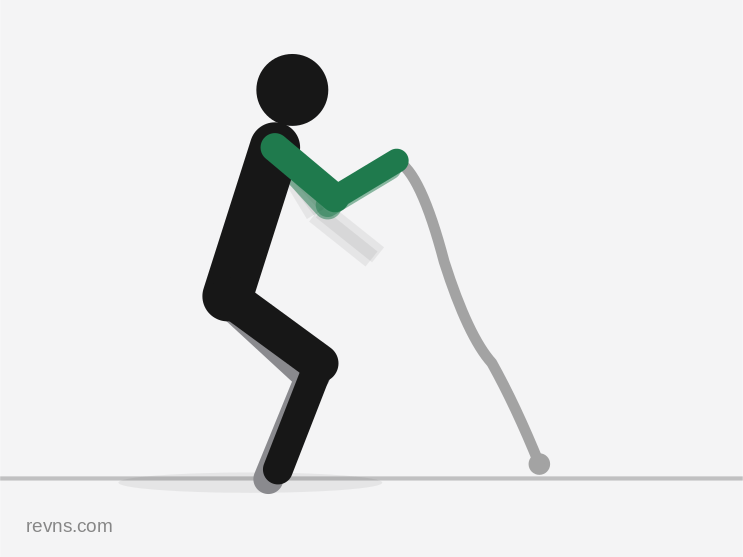
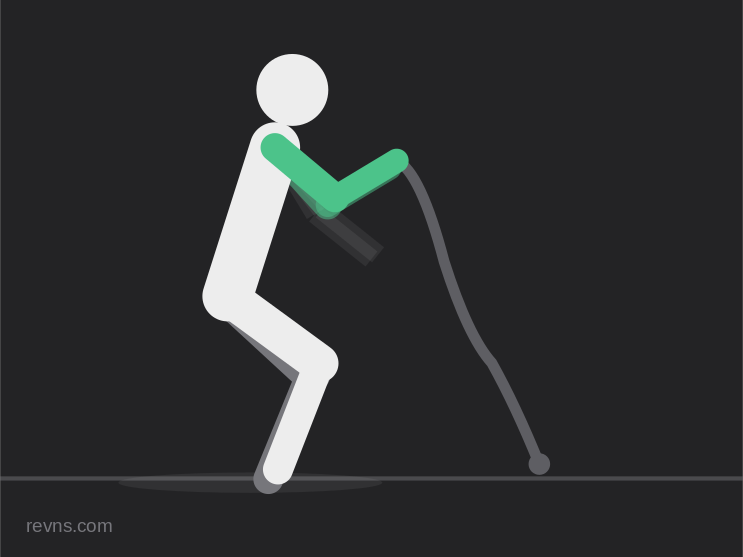
- Hold one end in each hand; stand in a half squat, chest up, core braced.
- Create waves by moving from the shoulders, not only the wrists.
- Keep both feet flat; do not stand tall and lose leg tension.
- Work 20 to 30 seconds, then rest until breathing slows.
Common mistake: standing upright and flipping small waves that die halfway down the rope. The fix is a deeper squat, longer ropes if yours are too short, and bigger shoulder movement.
Easier: slower waves, shorter work intervals, or jumping jacks and marching until ropes are available. Harder: burpees, heavier rope diameter, or medicine ball slams. Similar: rowing machine sprints, kettlebell swings, Tabata-style bodyweight circuits.
A simple battle ropes workout plan
Use this after a warm-up and never as the only training you do in the week.
Warm-up (5 minutes)
- 2 minutes brisk marching
- 10 bodyweight woodchops each side
- 20 seconds easy rope waves, rest 40 seconds
Main set — beginner (week 1–2)
| Round | Work | Rest |
|---|---|---|
| 1–4 | 15 s waves | 60 s |
| 5–6 | 20 s waves | 75 s |
Stop if grip fails or shoulders pinch.
Main set — intermediate (week 3+)
| Round | Work | Rest |
|---|---|---|
| 1–6 | 25 s double waves | 60 s |
| 7–8 | 25 s alternating waves | 75 s |
| 9–10 | 30 s double waves | 90 s |
Total rope time is about 8 to 12 minutes of work plus rest — enough for a conditioned finisher when form stays clean.
Track heart rate: if you wear a watch, note peak heart rate and how fast it drops in the first minute of rest; compare week to week with the heart rate zone calculator. On iPhone, revns reads workouts, heart rate, HRV and sleep from Apple Health (read-only) so rope days sit next to recovery trends.

Battle ropes vs other conditioning tools
| Tool | When to pick it |
|---|---|
| Battle ropes | Short upper-body MetCon, no leg impact, gym or outdoor anchor |
| Rowing machine | Full-body cardio, measurable pace, quieter indoors |
| Burpees | No equipment; more leg and impact load |
| Assault bike | Hard intervals with less shoulder demand |
| Zone 2 walk or cycle | Building aerobic base; see zone 2 cycling and walking |
Ropes shine when you want shoulder and grip under fatigue. They are a weak choice as your only cardio if you avoid leg work entirely.
Are battle ropes hard on the shoulders or back?
They can be if volume jumps too fast or the back rounds in the squat. In the basketball-player study above, participants reported substantial perceived soreness in the upper limbs and trunk after rope exercise in that protocol — expected after novel hard work, not a reason to ignore pain.
Ease in with shorter rounds. Keep the chest up and core braced. If you have a recent shoulder injury, rotator cuff problem or herniated disc under care, get clearance before rope intervals. Stop for sharp shoulder or neck pain, numbness down the arm, fainting, or chest pain.
What to do this week
- Find a safe anchor and rope length; do one session of 4 × 15 s waves with 60 s rest.
- Add one round per week until you reach 6 × 20 s if shoulders and grip stay comfortable.
- Place rope day after leg strength or on a dedicated cardio day, not before heavy squats.
- Log sleep and resting heart rate the morning after; a big spike may mean the dose was too high.
- Keep at least one full rest or easy day after a hard rope session.
When to see a professional
Get medical advice for shoulder pain that does not ease after a lighter week, elbow swelling, dizziness or fainting during intervals, chest pain or pressure, or breathlessness that feels wrong for your fitness. This is general training guidance, not medical advice. Battle ropes are not treatment for heart, lung or joint conditions.
If rope work worsens mood because you dread it every session, swap to another conditioning mode you can sustain; consistency beats one brutal tool.
Related
- Low impact cardio workout at home: a quiet beginner circuit
- Zone 2 training explained: what it is, how to find it, how much to do
- Tabata workout for beginners at home
- Benefits of overhead press: what they train, how often and a simple plan
- Rest days: how many you need and what to do on them
- Battle ropes in the exercise library
This is general training guidance, not medical advice.
Sources
- Ratamess NA et al. Comparison of the acute metabolic responses to traditional resistance, body-weight, and battling rope exercises. J Strength Cond Res 2015.
- Calatayud J et al. Muscle activity during unilateral vs bilateral battle rope exercises. J Strength Cond Res 2015.
- Chen WH et al. Acute effects of battle rope exercise on performance, blood lactate levels, perceived exertion, and muscle soreness in collegiate basketball players. J Strength Cond Res 2020.
- Bull FC et al. WHO Guidelines on Physical Activity and Sedentary Behaviour. Br J Sports Med 2020.
Terms in this post
revns publishes training and nutrition guidance, not medical advice. See a clinician for symptoms, injury or a medical condition. Accurate as of November 23, 2026.