Benefits of push-ups: what they train, how often and a simple plan
Benefits of push-ups: chest, shoulders, triceps and core with no equipment. Weekly sets, morning vs daily myths, and when to see a clinician.
revns editorial · Published November 24, 2026 · 9 min read
Push-ups are a compound upper-body move: pecs, delts, triceps and core. Progress from incline or knee reps; 2–4 days a week, 3 sets near fatigue beats daily failure.
The benefits of push-ups are stronger chest, shoulders and triceps, better core stability, and useful upper-body volume with no equipment. A push-up lowers and raises your body in a straight line while your arms bend. Most adults build strength with two to four sessions a week, 2 to 4 sets taken close to fatigue with clean form, not by failing every day. Scale from wall or knee push-ups until full reps are steady.
TL;DR
| Question | Short answer |
|---|---|
| Muscles | Chest, front shoulders, triceps; core and glutes brace |
| Health benefits | Meets part of WHO/NHS twice-weekly strength targets; supports posture and pressing |
| How often | 2–4 days/week for most; daily max reps often overuse wrists/shoulders |
| Sets and reps | 3 × 6–15 (or as many good reps as you can leave 1–2 in the tank) |
| Progress | More reps, then harder angle (knee → full → decline or slower tempo) |
| Red flags | Sharp shoulder, wrist or chest pain; numbness; see a clinician |
What muscles do push-ups work?
In a standard push-up, you support your body on hands and toes (or knees), lower your chest toward the floor, and press back up. The main movers are:
- Pectoralis major — horizontal push, especially with hands near shoulder width.
- Anterior deltoid — front shoulder lifts and stabilises the arm.
- Triceps brachii — straightens the elbow on the way up.
Stabilisers include rectus abdominis and obliques (anti-extension), gluteus maximus (hips level), serratus anterior (shoulder blade on the rib cage), and rotator cuff muscles around the shoulder.
| Hand width | Typical emphasis |
|---|---|
| Slightly wider than shoulders | Chest |
| Hands under shoulders | Balanced chest and triceps |
| Narrow (diamond-style) | Triceps; more wrist/shoulder demand |
Searchers ask "push ups muscles worked" — the pattern is a horizontal press using body weight instead of a barbell bench press.
What are the benefits of push-ups?
Upper-body strength without a gym
Push-ups let you load pressing muscles anywhere. A 2021 network meta-analysis in Medicine & Science in Sports & Exercise (López et al., 28 studies, 747 healthy adults) found muscle hypertrophy did not differ meaningfully between low, moderate and high loads when sets went to volitional failure; bodyweight push-ups in the 6–15 rep range fit that model when you stop near fatigue with good technique.
Meets public strength guidelines
The WHO recommends muscle-strengthening activities at least two days a week for all major muscle groups (Bull et al., British Journal of Sports Medicine, 2020). Push-ups cover chest, shoulders and arms in one move. Pair them with rows, squats or carries so the back and legs are not neglected.
The NHS advises muscle-strengthening on at least two days a week working major groups. A week with push-ups twice plus leg work moves closer to that pattern than arm work alone.
Core and posture carryover
A proper push-up is a moving plank. Research on plank-style bracing shows sustained torso stiffness trains the trunk muscles that resist lower-back sag. Push-ups add shoulder and elbow motion on top of that brace, which helps desk posture and carrying tasks more than endless crunches alone.
Bone loading through the wrists and arms
Weight-bearing through the hands loads the wrists, elbows and shoulders. For healthy adults, gradual progress can support bone and tendon health alongside muscle; people with osteoporosis, recent fractures or rheumatoid arthritis should get individual advice before high-volume push-ups.
Pairing with pull-ups and rows
Search demand includes benefits of push-ups and pull-ups. Pressing (push-ups) and pulling (rows, pull-ups) balance the shoulder girdle. A week that only pushes forward without pulling often leaves the upper back weak; add band pull-aparts or rows if you cannot yet do pull-ups.
What are the health benefits of push-ups?
Health benefits of push-ups overlap with any consistent resistance habit: better strength for daily tasks, support for glucose and lipid health as part of overall activity, and mental well-being from regular movement (WHO includes mental health in its physical activity rationale).
Push-ups alone do not:
- Spot-reduce chest fat or "tone" breasts; body composition changes need food, sleep and full-programme training over months.
- Replace moderate aerobic work. WHO still recommends 150–300 minutes of moderate cardio per week for adults unless your clinician advises otherwise.
They do offer a low-barrier strength option when you cannot reach a gym—useful after travel, in small flats, or inside a calisthenics progression.
Are push-ups good for women?
Yes. Benefits of push-ups for women match functional strength: pushing doors, lifting children, supporting yoga or swimming, and balance with pulling work in strength training for women. Start with incline or knee versions if full reps wobble the hips.
Claims about breast size or weight loss from push-ups are not supported by exercise physiology. Muscle under the chest may feel firmer; bra fit and body fat change with whole-programme training and nutrition, not one exercise.
Benefits of push-ups for men
Men often search benefits of push-ups for men or everyday for males. The physiology is the same: chest, shoulders and triceps gain strength when volume and difficulty rise over weeks. Daily 100-push-up challenges frequently irritate wrists and fronts of shoulders; progressive sets twice a week usually build strength more safely.
Is it good to do push-ups every day?
Not necessary, and often counterproductive. Benefits of push-ups daily are mostly habit, not extra muscle. Tendons and joints recover on a 48-hour scale after hard sets.
| Approach | Typical outcome |
|---|---|
| 2–4 sessions/week, 3 hard sets | Strength up; joints usually tolerate load |
| Easy knee push-ups most days | Active recovery; keep reps low |
| Max reps every day | Wrist/shoulder irritation; stalled strength |
The American College of Sports Medicine beginner guidance suggests learning patterns with moderate volume before chasing high daily totals. If you love a morning ritual, keep most days easy (wall or 5–10 perfect knee reps) and place hard sets on non-consecutive days. See rest days and DOMS.
Benefits of push-ups in the morning
Time of day does not change muscle recruitment. Morning push-ups suit people who want movement before work if shoulders feel loose after two minutes of arm circles and easy wall presses. Others do better in the afternoon when body temperature is higher.
There is no evidence that morning push-ups burn more fat than evening ones. Choose the time you repeat consistently and that does not cut sleep.
Benefits of push-ups before bed
Late push-ups are fine if they do not wire you up or hurt the shoulders on a firm mattress floor. Avoid max-effort sets right before sleep if your heart rate stays elevated. Gentle wall push-ups or mobility are a better wind-down than grinding failure reps.
How often should you do push-ups?
Two to four days a week with one rest or easy day between hard upper sessions fits most programmes that also train legs and pulls.
| Level | Weekly push-up focus | Notes |
|---|---|---|
| Beginner | 2 days, 3 × 8–12 knee or incline | Add incline height when sets are easy |
| Intermediate | 3 days, 3 × 10–15 full | One day can add pike push-ups for shoulders |
| Advanced | 3–4 days mixed | Variations (tempo, deficit) on one day only |
Leave 48 hours between sessions where sets are near failure. Log reps in a workout log so progress is visible over four weeks.
How many sets and reps of push-ups?
| Goal | Sets × reps | Rest | Notes |
|---|---|---|---|
| Strength and size | 3–4 × 6–12 | 60–90 s | Stop 1–2 reps before form breaks |
| Endurance | 3 × 15–20 | 45–60 s | Still avoid hip sag |
| Skill building | 5 × 5 perfect | 90 s | Slow lowering, 2–3 s |
Use how long to rest between sets as a default. When you beat the top of your rep range three sessions in a row, move to a harder variation or add one slow set rather than chasing endless daily volume.
How to do a push-up with good form
- Hands slightly wider than shoulders, fingers forward, middle finger points ahead.
- Brace ribs down; squeeze glutes so hips stay level with shoulders.
- Lower until the chest nears the floor (or as far as shoulders stay comfortable), elbows about 30–45° from the torso—not flared to 90°.
- Press up without letting hips pike up or sag toward the floor.
- Breathe: inhale down, exhale on the press (either pattern is fine if you do not hold breath strain).
Common mistake: hips drop or head juts forward. Fix: start with knee push-ups or hands on a bench/wall until you can hold a plank 20–30 seconds.
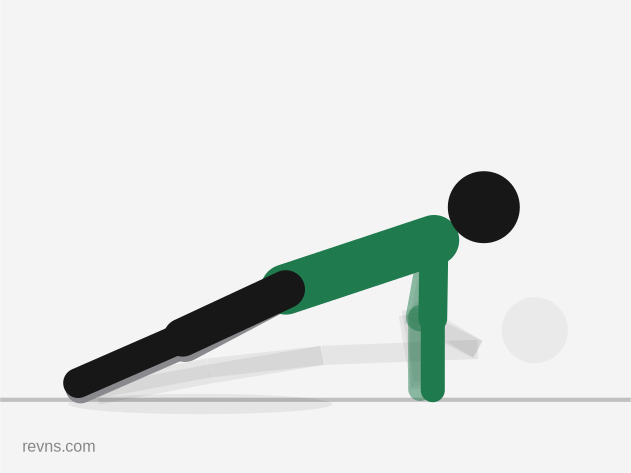
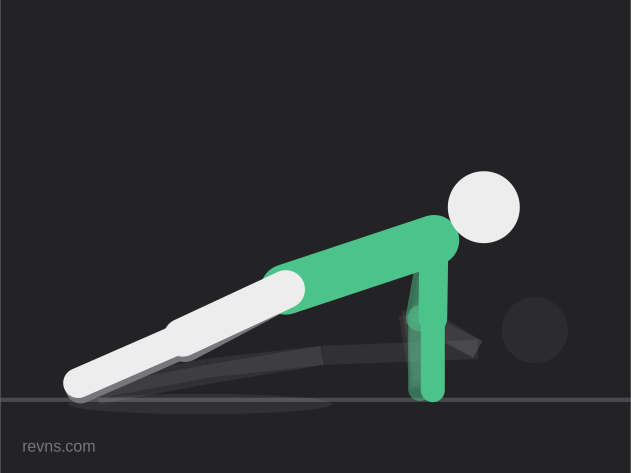
Easier: Knee push-ups or wall push-ups with hands on a counter. Harder: feet elevated, slower lowering (3–4 s), or pair with dips on a separate day.
A simple push-up workout plan (three days a week)
Each session takes about 15 minutes after a warm-up. Do this on non-consecutive days or separate from heavy overhead press days if shoulders feel beat up.
Day A
| Exercise | Sets × reps | Rest |
|---|---|---|
| Push-ups (or knee) | 3 × 8–12 | 60 s |
| Band pull-aparts | 2 × 15 | 45 s |
Day B (two days later)
| Exercise | Sets × reps | Rest |
|---|---|---|
| Push-ups | 3 × max good reps (leave 2 in tank) | 75 s |
| Bodyweight squat or lunge | 3 × 12 | 60 s |
Day C (two days after B)
| Exercise | Sets × reps | Rest |
|---|---|---|
| Knee or full push-ups | 4 × 6 slow lowering | 90 s |
| Plank hold | 2 × 20–40 s | 45 s |
Increase difficulty by removing knee support, adding one rep per set, or slowing the lower phase before you add a fourth push day.
Push-ups vs bench press and dips
| Move | Load | Best for |
|---|---|---|
| Push-up | Body weight, scalable | Home, travel, learning press pattern |
| Bench press | Barbell/dumbbell | Max strength with external load |
| Dips | Body weight, shoulder extension | Lower chest and triceps emphasis |
Many programmes use push-ups as the main press until full reps are easy, then add weights or dips for variety—not all three heavy on the same day.
Wall push-ups and other variations
Health benefits of wall push-ups match the same muscles at a lighter load: ideal for rehab return, pregnancy modifications when cleared, or office movement breaks. Move the hands lower (bench, floor) as strength improves.
Knuckle push-ups change wrist angle; they do not magically build more chest. Use them only if wrists stay pain-free.
How do you track push-up progress?
Log variation, sets, reps and whether the last rep stayed strict. Progress when:
- All working sets hit the top of your rep range with level hips.
- You step to a harder angle for the same reps.
- Resting heart rate and sleep stay stable—signs load is tolerable (optional with Apple Health sync on iPhone through revns; other wearables on the roadmap).
Use progressive overload: small steps beat sudden daily doubling.
What to do this week
- Test how many full or knee push-ups you do with strict hips. Write the number down.
- Schedule two sessions (Days A and B above). Stop each set with one or two reps left.
- Add one pull or row pattern so the back matches the chest—see calisthenics for beginners.
- Keep one full rest or easy day before your next hard upper session.
When to see a professional
Get medical advice for chest pain or pressure during push-ups, sharp shoulder or wrist pain, numbness or tingling in the arm, pain after a fall onto an outstretched hand, or shoulder instability (a joint that slips). Pregnancy and postpartum trainees should follow clinician guidance on floor pressure and diastasis. This is general training guidance, not medical advice.
Related
- Benefits of dips: what they train, how often and a simple push plan
- Benefits of overhead press: what they train, how often and a simple plan
- Calisthenics for beginners: push-up to pull-up progressions
- Strength training for beginners: the first eight weeks
- Core workout for beginners at home
- How many sets per muscle per week for muscle growth
- Push-ups exercise library page
This is general training guidance, not medical advice.
Sources
- Bull FC et al. WHO Guidelines on Physical Activity and Sedentary Behaviour. Br J Sports Med 2020.
- NHS. Physical activity guidelines for adults aged 19 to 64. Updated guidance on strength and cardio.
- López P et al. Resistance Training Load Effects on Muscle Hypertrophy and Strength Gain: Systematic Review and Network Meta-analysis. Med Sci Sports Exerc 2021.
- American College of Sports Medicine. ACSM's Guidelines for Exercise Testing and Prescription, 11th ed. Wolters Kluwer.
- Cogley RM et al. Comparison of muscle activation using different hand positions during the push-up exercise. J Strength Cond Res 2005.
- Schoenfeld BJ et al. Effects of different volume-equated resistance training loading strategies on muscular adaptations in well-trained men. J Strength Cond Res 2014.
Terms in this post
revns publishes training and nutrition guidance, not medical advice. See a clinician for symptoms, injury or a medical condition. Accurate as of November 24, 2026.