Planning a training week: hard days, easy days and where rest fits
A weekly workout plan that lasts stacks hard days, easy Zone 2 and rest. WHO baselines, sample weeks for lifters and runners, and when to swap a hard session.
revns editorial · Published November 17, 2026 · 7 min read

Plan two or three hard sessions, easy cardio between them, and at least one rest day. WHO asks 150 min moderate activity plus strength twice weekly; adjust when sleep or stress dips.
A weekly workout plan that lasts is mostly easy days with a few hard ones placed on purpose. Most adults thrive on two or three hard sessions, easy movement on the days between, and at least one rest day that matches sleep and life stress. The WHO recommends about 150 to 300 minutes of moderate aerobic activity per week for 18 to 64 year olds, plus muscle strengthening on at least two days. That framework is not a calendar to photocopy; it is the guardrail you bend when work, travel or a cold week intervenes.
TL;DR
| Piece of the week | What it usually is | How often |
|---|---|---|
| Hard strength | Compounds, heavy sets, near-failure work | 2–3 days, not back-to-back legs |
| Hard cardio | Intervals, tempo, long hilly run | 0–2 days, apart from leg day if possible |
| Easy cardio | Zone 2, brisk walk, easy cycle | 2–4 days |
| Mobility | 10-minute daily routine | Most days, especially before lifts |
| Full rest | No structured training stress | 1+ day |
What should a weekly workout schedule look like?
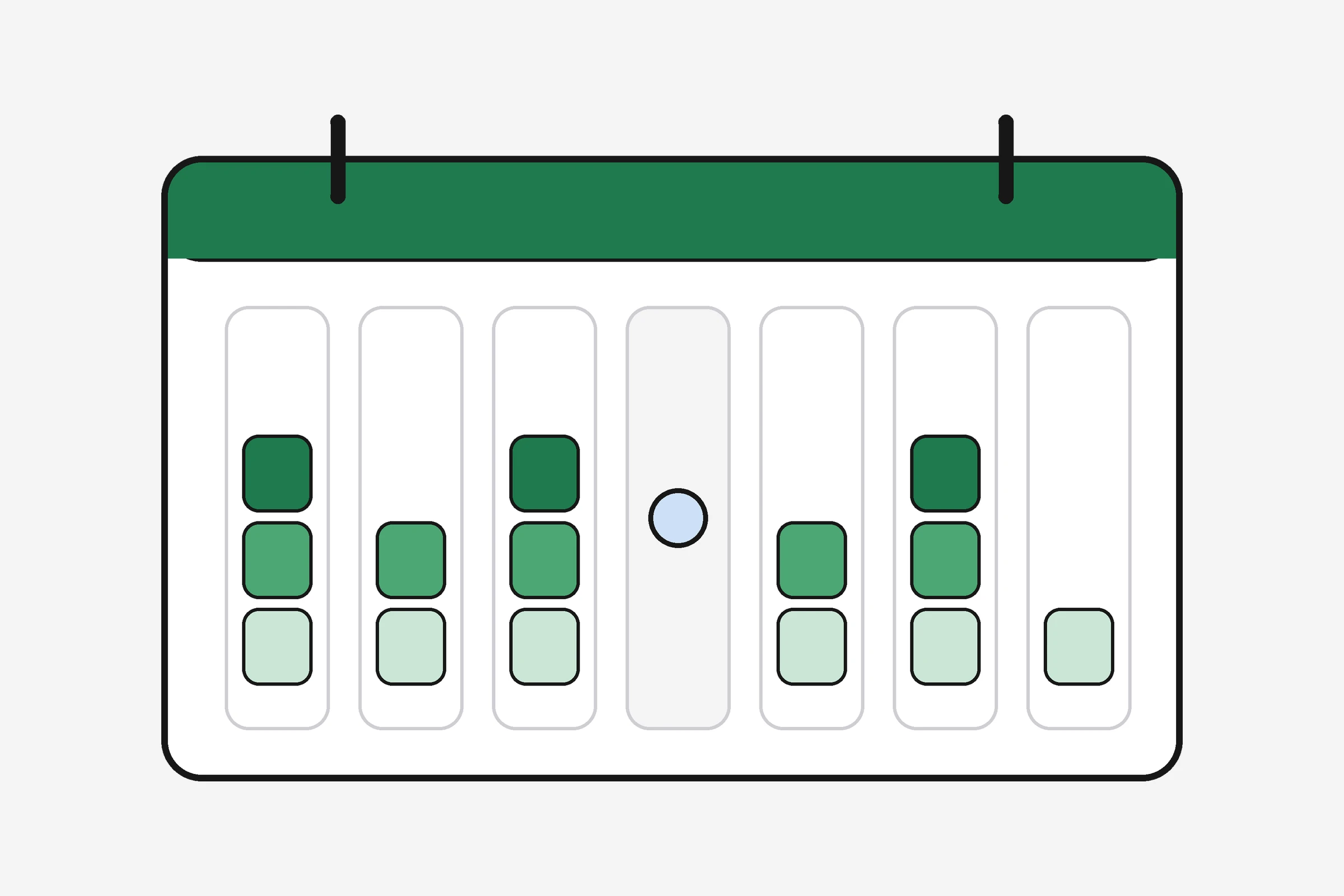
A workable week alternates stress and recovery. Public health bodies describe minutes and muscle days, not exact splits. The WHO guidelines on physical activity (2020) ask adults 18 to 64 to do 150–300 minutes of moderate aerobic activity, or 75–150 minutes of vigorous activity, or an equivalent mix, plus muscle strengthening on 2 or more days that work major groups.
For someone who already trains, that often translates into:
- Two or three resistance sessions that cover squat, hinge, push and pull patterns across the week.
- Two or four aerobic sessions, most at easy effort, one optionally harder.
- Steps and mobility on days that are neither hard nor empty.
The schedule is wrong if hard efforts touch without a buffer — for example heavy squats Monday, intervals Tuesday, heavy deadlifts Wednesday — unless you are an experienced athlete with deliberate nutrition and sleep. For most readers, space hard days with easy or rest days.
Use a workout split tracker so you know whether legs, pull or push is due, not whether you feel like benching again.
How do you create a weekly workout plan step by step?
Start from the week you have, not the week on a poster.
Step 1: Lock non-negotiables
Mark work hours, family commitments and sleep targets. If you can only train at 6 a.m. three days, the plan has three doors, not six.
Step 2: Place hard sessions first
Pick two or three anchor sessions:
- Strength: full body (beginners) or upper/lower or push/pull/legs (intermediate).
- Cardio: one long easy run or ride plus optional one tempo or interval day.
Put the hardest lift day after a rest or easy day when possible.
Step 3: Fill with easy work
On remaining days, schedule 30–45 minutes of easy cardio or a daily mobility routine. Easy work supports WHO minute totals without digging the same hole as intervals.
Step 4: Name rest
Block one full rest day. If the week was brutal, take two. Rest days are part of the programme, not a failure.
Step 5: Review every two weeks
Compare sleep, mood and session quality. If the same weights feel heavier and irritability is up, hold volume and add easy days before you add another hard slot. Subjective wellness trends beat one tired morning.
What is a good weekly workout plan for beginners?
Beginners usually do best with two or three full-body strength days and walking on other days. The American College of Sports Medicine (ACSM) recommends resistance training on 2–3 days per week for adults, with 8–12 repetitions of 8–10 exercises that cover major muscle groups when health allows. Early weeks favour technique and consistency over split complexity.
Sample beginner week (gym or home dumbbells)
| Day | Session |
|---|---|
| Monday | Full-body strength A (squat pattern, push, row) |
| Tuesday | 30-minute brisk walk |
| Wednesday | Rest or 10-minute mobility |
| Thursday | Full-body strength B (hinge, press, pull) |
| Friday | Easy 20–40-minute walk |
| Saturday | Optional light strength or long walk |
| Sunday | Rest |
Link the lifts to strength training for beginners for exercise choice. Use the one-rep-max calculator only once you have months of logged sets; early on, reps in reserve matter more than a calculated max.
What should a weekly workout plan look like if you run and lift?
Separate hard run and hard leg days when you can. Runners who lift often use:
| Day | Focus |
|---|---|
| Mon | Easy run |
| Tue | Upper-body strength |
| Wed | Rest or mobility |
| Thu | Intervals or tempo (hard cardio) |
| Fri | Lower-body strength (moderate volume) |
| Sat | Long easy run |
| Sun | Rest or walk |
If a race is near, shorten lifts before the long run, not after. Use the running pace calculator to keep easy days truly easy.
What is a good weekly workout plan for four-day strength trainers?
Four-day lifters usually rotate upper and lower twice, with easy cardio or rest between duplicate patterns.
| Day | Session |
|---|---|
| Monday | Lower body A (squat emphasis) |
| Tuesday | Easy 30-minute cycle or walk |
| Wednesday | Upper body A (press and row) |
| Thursday | Rest or mobility |
| Friday | Lower body B (hinge emphasis) |
| Saturday | Upper body B (pull emphasis) |
| Sunday | Rest |
Each lower day stays moderate volume (roughly 10–16 hard sets for legs) so Friday does not repeat Monday's fatigue. Upper days can sit between lower days because grip and shoulder stress differ from knee and hip load. This is a template, not medical clearance for anyone with recent joint surgery.
Intermediate trainees often add one optional interval run on Tuesday or Saturday if sleep is solid. Drop that run first when HRV or resting heart rate trends worse for a week — the signal is a pattern, not one bad reading.
How do hard days and easy days differ in practice?
Hard days cost recovery; easy days pay it back.
| Hard day sign | Easy day sign |
|---|---|
| Breathing is laboured for sustained blocks | You can speak in full sentences |
| Weights are heavy for low reps or near failure | Loads feel light; technique focus |
| Soreness peaks 24–48 hours later | Little or no next-day heaviness |
| Session needs real fuel and sleep after | Session feels better, not worse, next morning |
Zone 2 training belongs on easy days. Intervals and heavy singles belong on hard days. Mixing them on the same day is for athletes with structured coaching, not default planning.
How does training load change when stress or sleep slip?
Stress and short sleep count as load. The 2013 joint statement on overtraining from the European College of Sport Science and the American College of Sports Medicine lists life stress and inadequate recovery among triggers, not only workout volume. A spreadsheet week that ignores sleep is incomplete.
When sleep is short three or more nights or work stress spikes:
- Move the next hard session 48 hours later.
- Swap intervals for a 30-minute walk.
- Keep mobility if it feels good; stop if joints are hot or sharp.
Full detail sits in stress, sleep and training load. That guide is the adjustment layer on top of this template.
What should you do this week?
Pick one template — beginner full body, run plus lift, or four-day split — and run it 14 days before you redesign it.
- Write the seven boxes on paper or in revns: H (hard), E (easy), R (rest).
- Log sleep hours and mood 1–5 on training days. Two weeks of dots reveal more than one hero session.
- Check the morning brief or rotation view if you use goal tracking: is a muscle group or session type overdue because you skipped easy days?
- Cap hard days at three until easy cardio feels automatic.
- Book a rest day before a social week, not after you are already flat.
If you coach others, the same week skeleton works in team boards: everyone sees hard versus easy intent without sharing private notes.
How can you track whether the week plan is working?
A plan works when quality repeats, not when every day feels heroic. After two weeks, check:
- Completion: Did hard days happen on the days you marked H, or did they slide because easy days were missing?
- Pace and load: Are easy runs still conversational? Are top sets moving or stalling?
- Sleep and mood: Use the same 1–5 mood note as in how to track mood and energy.
- Rotation: If you use revns, the AI fitness coach can read sleep and session scores together through MCP when you connect an assistant — pattern spotting only, not a diagnosis.
Spreadsheet users can copy the workout log template: one row per day with columns for H/E/R and session notes. Apps reduce friction; paper still works if you will read it.
When should you see a professional instead of editing the plan?
See a clinician or physio when:
- Pain is sharp, in a joint, or unchanged for two weeks despite easier weeks.
- Chest pain, fainting or dizziness happens with exercise.
- Mood stays low or hopeless for more than two weeks, or you have thoughts of self-harm. In the UK call Samaritans on 116 123; in the US call or text 988.
- Sleep stays broken despite routine changes.
A training plan cannot diagnose overtraining syndrome, heart disease or depression. It only structures movement while you get care.
Related
- Rest days: how many you need and what to do
- Workout split tracker: which muscle groups are due next
- Recovery in training: what it means and how to tell you have recovered
- Stress, burnout and when to deload
This is general training guidance, not medical advice.
Sources
- World Health Organization. WHO guidelines on physical activity and sedentary behaviour. 2020
- American College of Sports Medicine. ACSM's Guidelines for Exercise Testing and Prescription. 11th ed. Wolters Kluwer; 2021
- Meeusen R, Duclos M, Foster C, et al. Prevention, diagnosis and treatment of the overtraining syndrome: joint consensus statement of the European College of Sport Science and the American College of Sports Medicine. Eur J Sport Sci. 2013;13(1):1-24
- UK Chief Medical Officers. UK physical activity guidelines. 2019
Terms in this post
revns publishes training and nutrition guidance, not medical advice. See a clinician for symptoms, injury or a medical condition. Accurate as of November 17, 2026.