How to run faster: easy miles and one hard day per week
Run faster with mostly easy miles, one hard session weekly, two strength workouts, strides and sleep. Evidence, a sample week, and when to see a clinician.
revns editorial · Published November 16, 2026 · 7 min read

Keep most runs easy at conversational pace, add one hard session weekly, lift twice for legs, sleep enough, and raise mileage slowly. Track pace trends, not every run.
You run faster when most of your weekly mileage is easy, one session is honestly hard, and you recover with sleep and gradual load. Elite endurance athletes in studies by Stephen Seiler and colleagues often do roughly three quarters of their sessions at low intensity and one quarter at high intensity — the pattern people call polarised training or the 80/20 split. For a regular adult, that usually means three or four conversational runs, one interval or tempo day, and two short strength sessions. Chase pace trends over four to eight weeks, not a magic workout.
TL;DR
| Question | Practical answer |
|---|---|
| Best weekly shape | 3–4 easy runs + 1 hard session + 2 strength days |
| Easy pace | Zone 2: talk in full sentences |
| Hard session examples | Intervals, tempo blocks, or hill repeats (pick one) |
| Long run | +10 min every 1–2 weeks, stay easy |
| Strides | 6–8 × 80–100 m after an easy run, full recovery |
| Mileage rule | Rough 10% weekly increase cap; repeat a week if sore |
| Track progress | Same loop monthly; use the running pace calculator |
| Red flags | Chest pain, bone pain, collapse — stop and get assessed |
How to run faster: what actually works?
Sustained speed comes from aerobic base, one weekly quality stimulus, strength, and recovery — not from making every run hard. Randomised trials and meta-analyses keep showing the same outline:
- Easy volume raises stroke volume, capillary density and fat oxidation — you hold a pace with less strain.
- High-intensity work (intervals, hills, tempo) raises VO2 max and lactate threshold in many populations. A 2015 meta-analysis by Milanović and colleagues in Sports Medicine pooled 28 controlled trials in healthy adults aged 18–45: both HIIT and continuous endurance training raised VO2 max versus no exercise, and HIIT added a small extra gain versus endurance training alone (about 1.2 mL·kg⁻¹·min⁻¹ on average).
- Strength training improves running economy — how much oxygen you need at a given pace. A 2008 systematic review by Yamamoto and colleagues in the Journal of Strength and Conditioning Research of five studies in competitive distance runners found that concurrent resistance and endurance training likely improved running economy, with two trials reporting roughly 3% faster times over 3K–5K.
No single session delivers all three. That is why the week is split.
Why should most runs stay easy?
Easy running is how you accumulate minutes without breaking down. The talk test still works: if you can speak in full sentences but would not sing, you are in the right neighbourhood for zone 2. Seiler’s observational work in elite rowers, cyclists and runners shows about 75–80% of sessions at low intensity and 15–20% at high intensity — not half and half.
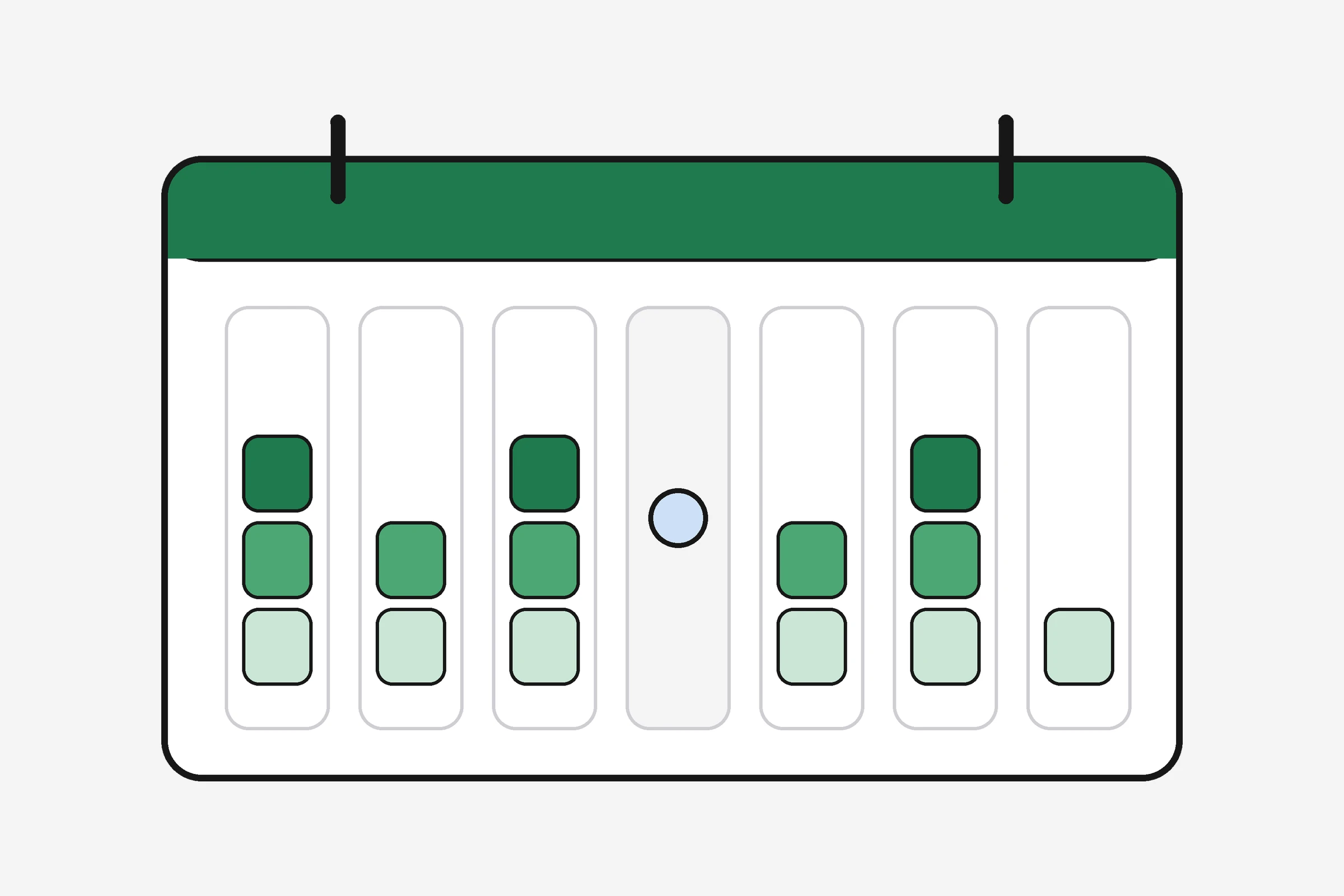
For someone who runs three times a week today, a realistic “mostly easy” week might look like:
| Day | Session | Effort |
|---|---|---|
| Mon | Rest or walk | — |
| Tue | 35 min easy run | Conversational |
| Wed | Strength 25 min | Legs and core |
| Thu | 40 min easy + strides | Easy, then 6 × 80 m smooth fast |
| Fri | Rest | — |
| Sat | Hard session (see below) | Breathing laboured by the end |
| Sun | 50 min easy long run | Still conversational |
If you only run twice a week, keep both easy for a month before adding a third day; the Couch to 5K plan is the usual on-ramp.
What should your one hard day look like?
Pick one primary quality format for the block — rotate every few weeks if you want variety, but not every workout type at once.
Option A — Short intervals (good for 5K speed)
After 15 minutes easy:
6 × 3 minutes at roughly 5K effort (breathing hard, controlled form), 2 minutes walk or very slow jog between.
Cool down 10 minutes easy.
Option B — Tempo (good for “holding on” in a race)
After 15 minutes easy:
15 to 25 minutes steady at comfortably hard pace — you could say a few words but not chat.
Cool down 10 minutes.
Option C — Hills (good for strength and form)
Find a moderate hill 60 to 90 seconds long.
8 repeats at strong effort, jog back down.
Finish with 10 minutes easy on flat ground.
Hard is relative. Use heart rate zones or perceived effort if you lack race data. One hard day is enough for most recreational runners; adding a second before sleep and easy volume are solid usually backfires.
If you are returning from a layoff, spend two to four weeks rebuilding easy minutes before you touch intervals. The same polarised pattern applies whether you run 15 kilometres a week or 60: protect easy days so the hard day can actually be hard, not another grey-zone jog that never fully recovers.

How do strength sessions fit in?
Two 20 to 30 minute strength sessions a week support running economy and bone health. Prioritise:
- Squat pattern: goblet squat or split squat, 3 × 8–12
- Hinge: Romanian deadlift or kettlebell hinge, 3 × 8–10
- Single-leg: step-ups or lunges, 3 × 8 each leg
- Calf: bent-knee and straight-knee raises, 2 × 12–15
- Core: plank variations, dead bug, 2 × 30–45 s
You do not need a gym. Vegetarian, vegan and non-vegetarian diets all work if protein is adequate; see how much protein per day. Schedule strength on non-hard run days or after an easy run, not right before intervals.
How should you build mileage without injury?
The familiar 10% rule — do not raise weekly running time by more than about 10% — is a guardrail, not a law. A 2014 prospective study in the Journal of Orthopaedic & Sports Physical Therapy following novice runners linked increases above about 30% in weekly distance over two weeks with higher rates of some distance-related injuries (runner’s knee, shin pain, tendinopathy), though total injury counts across progression groups were not clearly different.
Practical rules:
- One knob at a time: add either distance or intensity, not both in the same week.
- Repeat a week that felt too hard — sore shins, disrupted sleep, resting heart rate up several beats.
- Keep one full rest day minimum; see rest days how many you need.
- Rotate shoes if you run on roads daily; surface matters for load.
How do sleep and stress affect speed?
You cannot out-train poor sleep. Short nights raise perceived effort and blunt adaptation. Adults commonly need seven or more hours; the sleep guide cites CDC ranges. If HRV or resting heart rate trend worse for several days alongside heavy legs, ease the next hard session to easy — the same signal logic as deload weeks in stress, burnout and when to deload.
How do you know you are getting faster?
Test the same condition every few weeks:
- Pick a flat route or track segment you know.
- Run 20 to 30 minutes easy at your usual conversational effort.
- Note average pace or heart rate at that effort.
If pace at the same heart rate drifts down over a month, aerobic fitness is improving. For race-specific checks, use the running pace calculator to turn a recent 5K or parkrun time into training paces.
revns lets you log runs, sleep and resting heart rate in one place and view workout trends over time; wearable auto-sync is limited to what your import path supports — Apple Health sync for steps, sleep, heart rate and recorded workouts is available through the revns iPhone app (read-only). Enter other sessions manually if needed.
What should you do this week?
If you run twice a week today
- Make both runs easy for two more weeks. Add five minutes to one run.
- Add a third easy run.
- Week four: insert one hard session from the options above.
If you already run four times a week
- Label three runs easy and one hard.
- Add strides once after an easy day.
- Add two strength sessions.
- Log sleep and mood next to training for two weeks (mood and energy tracking).
When should you see a professional?
Stop and get medical assessment for:
- Chest pain, pressure, or pain spreading to arm or jaw during or after running
- Fainting or near-fainting
- Stress fracture suspicion: pinpoint bone pain that worsens with every step
- Shin or foot pain that rises week after week despite load reduction
- Breathlessness out of proportion to effort, or blood in urine after extreme exertion
- Pregnancy or postpartum: follow clinician guidance before increasing intensity (pregnancy movement guide)
If worry about performance is harming mood or sleep, speak to a clinician or your local crisis line. Training guidance cannot replace care.
Related
- Zone 2 training explained
- VO2 max: what it is and how to raise it
- Couch to 5K: a realistic plan
- Progressive overload in plain words
- Running pace calculator
- Heart rate zone calculator
- Multi-sport workout tracker
This is general training guidance, not medical advice.
Sources
- Milanović Z, Sporiš G, Weston M. Effectiveness of high-intensity interval training (HIT) and continuous endurance training for VO2max improvements: a systematic review and meta-analysis of controlled trials. Sports Med 2015
- Yamamoto LM, et al. The effects of resistance training on endurance distance running performance among highly trained runners: a systematic review. J Strength Cond Res 2008;22(6):2036–2044
- Seiler S. What is best practice for training intensity and duration distribution in endurance athletes? Int J Sports Physiol Perform 2010
- Nielsen RO, et al. Excessive progression in weekly running distance and risk of running-related injuries: an association which varies according to type of injury. J Orthop Sports Phys Ther 2014
- World Health Organization. Physical activity fact sheet (updated November 2026)
Terms in this post
revns publishes training and nutrition guidance, not medical advice. See a clinician for symptoms, injury or a medical condition. Accurate as of November 16, 2026.