Sleep consistency and heart health: what a 2026 All of Us study of 10,362 adults found
A 2026 Circulation study ties variable bedtimes and sleep length to higher heart and stroke risk in 10,362 Fitbit users—not average hours alone.
revns editorial · Published November 24, 2026 · 7 min read

Circulation Outcomes 2026: 29 minutes more night-to-night sleep-duration variability (1 SD) linked to HR 1.24 for a CVD composite in 10,362 Fitbit users; mean duration was not linked.
An irregular sleep schedule—shifting bedtimes, wake times and night length—not just short sleep, was linked to higher cardiovascular risk in a 2026 peer-reviewed cohort study in Circulation: Population Health and Outcomes. Researchers studied 10,362 US adults in the NIH All of Us Research Program with Fitbit nights tied to medical records. Over a median 3.7 years of follow-up, greater sleep regularity (lower night-to-night variability) mattered for a heart-and-stroke composite; average sleep duration in the baseline window did not. That is an association, not proof your late Friday caused disease—but it is a practical reason to keep wake time steady when you already track how much sleep you need.
TL;DR
| What researchers did | What they found |
|---|---|
| Who | 10,362 adults (median age 53; 70% women) with linked Fitbit + EHR in All of Us |
| Sleep window | 180-day baseline, ≥90 valid nights; then incident diagnoses after washout |
| Follow-up | Median 3.7 years; 230 developed a CVD composite (MI, HF, cardiomyopathy, ischemic stroke) |
| Duration variability | Each 1 SD (= 29 min) higher night-to-night TST variability → HR 1.24 (95% CI 1.09–1.41) for the composite |
| Timing variability | Higher bedtime, wake time and midpoint variability also linked (HR ~1.20–1.23) |
| Mean duration | Not associated with the composite (HR 0.96, CI crosses 1.0) |
| Caveat | Observational; early illness can disturb sleep; sample mostly women |
What did the new sleep consistency and heart health study find?
Nguyen, Tran and colleagues published "Sleep and Cardiometabolic Disease: A Wearable–Electronic Health Record Study in the US All of Us Research Program" in November 2026 in Circulation: Population Health and Outcomes. The work uses longitudinal wearable data—about six months of nights per person—not the single-week snapshots common in older regularity papers.
Methods in brief
- Cohort: US participants in All of Us with both Fitbit sleep and electronic health records (2009–2023 window in the paper).
- Baseline: 180 days with ≥90 valid main-sleep nights; 11 sleep metrics including mean total sleep time, wake after sleep onset, and regularity (standard deviation of nightly duration; circular standard deviations of bedtime, wake time and sleep midpoint in minutes).
- Outcomes: Incident diagnoses grouped into disease codes, counted after a 180-day washout to limit reverse causation (sick people sleeping worse before diagnosis).
- Primary composite: Myocardial infarction, heart failure, cardiomyopathy, or ischemic stroke.
- Models: Cox regression with adjustment for demographics, socioeconomic factors, lifestyle and comorbidity.
Main results
Among 10,362 participants, 230 developed the cardiovascular composite. Each one standard deviation increase in night-to-night sleep-duration variability (29 minutes in this sample) carried an adjusted hazard ratio of 1.24 (95% CI 1.09–1.41). Bedtime variability (HR 1.23), wake-time variability (1.20) and midpoint variability (1.21) showed similar links.
By contrast, mean sleep duration across the baseline window was not associated with the composite (HR 0.96, 95% CI 0.85–1.08). Duration variability was also linked to heart failure, hypertension and type 2 diabetes in adjusted models at thresholds the authors report.
Exploratory sleep-architecture finding: In a subset with stage data, more wearable-estimated sleep cycles were associated with lower atrial arrhythmia risk; the authors call that novel and needing confirmation.
The authors conclude that night-to-night irregularity in sleep duration and timing was associated with cardiometabolic endpoints, while mean duration was not associated with the cardiovascular composite in this analysis—a pattern that matches growing talk about sleep regularity beside duration in frameworks such as the American Heart Association’s Life’s Essential 8, which still scores sleep partly by hours alone.
How is sleep consistency connected to your heart and training?
Your circadian rhythm sets when you feel sleepy, when cortisol rises, and how blood pressure dips overnight. Cardiovascular epidemiologist Nour Makarem, who commented in lay coverage of the paper, notes that irregular sleep can align with higher nocturnal blood pressure and a non-dipping profile—blood pressure that does not fall enough during sleep—patterns linked in other work to heart disease and stroke risk, especially in women.
For people who train, three links matter:
- Recovery: Sleep and training load share a budget. Huge social jet lag (midnight weekends, 6 a.m. Monday alarms) stacks stress even when weekly hours average out.
- Heart-rate trends: Resting heart rate and HRV on your watch react to timing scatter. They are not diagnoses, but a two-week drift after every wild weekend is a nudge to fix the schedule before you add intensity.
- Food and movement timing: Late bedtimes often pair with late meals and missed morning walks. The Circulation paper adjusts for lifestyle factors, but your week still feels better when dinner, training and lights-out sit in a repeatable band.
Earlier observational work pointed the same direction. A 2024 Sleep study in 60,977 UK Biobank participants reported that sleep regularity predicted mortality risk more strongly than duration in its models—again, association not causation. The 2026 All of Us paper adds months of Fitbit nights and clinical endpoints in a US sample skewed female, which matters when you generalise to men or younger athletes.
Does this mean bedtime matters more than eight hours?
No. Short sleep still hurts mood, skill learning and gym performance in controlled and cohort studies. This paper’s headline is narrower: in this group, with these adjustments, variability in timing and length predicted incident cardiovascular diagnoses; mean length in the same window did not predict the composite.
If you currently sleep six hours on random clocks, fix duration and regularity together: pick a wake time you can hold, count backward for what time you should go to bed, and protect seven to nine hours when your schedule allows, per adult consensus statements cited in our sleep need guide.
If you already average enough hours but Friday is 1 a.m. and Sunday is 10 p.m., the study supports tightening that scatter before you chase another interval session.
How consistent does your sleep schedule need to be?
Searchers ask "how important is a consistent sleep schedule" and "sleep schedule consistency." The study did not publish a single bedtime curfew. Expert commentary on the paper—Marie-Pierre St-Onge at Columbia—suggests not drifting more than about 60 minutes from your usual bedtime or sleep duration, with smaller gaps better.
Practical targets for trainers:
| Habit | Starting target |
|---|---|
| Wake time | Same ±30 minutes seven days a week, including after social nights |
| Bedtime | Move in 10-minute steps per night if you are shifting earlier |
| Weekends | Keep bed and wake within ~60 minutes of weekday anchors when you can |
| After one bad night | Earlier bed or slightly later wake next day—not a three-hour lie-in that moves Monday’s rhythm |
| Tracking | Review four weeks of bedtime and duration SD in sleep tracking; ignore one red sleep score morning |

What should you do this week?
- Pick one wake time you can hit without snoozing through training—write it in your log or sleep calculator plan.
- Export or screenshot the last 30 nights of bedtime, wake and duration from Apple Health (via the revns iPhone app read path) or your watch. Note the spread: are weekends 90+ minutes off?
- Shift bedtime earlier by 10 minutes every two nights until you hit your target in-bed time for your needed hours.
- Keep hard intervals and heavy leg days on nights when bedtime variability was low in the prior week; swap in zone 2 or mobility when the schedule was chaotic.
- Log mood and energy next to sessions for two weeks—see how to track mood and energy next to training—so you separate irregular sleep from illness or overtraining.
Do not use hazard ratios to scare yourself after one wedding night. The paper’s 29-minute standard deviation is a population spread across ~90 nights, not a penalty for 29 minutes late once.
How does sleep consistency fit next to catch-up sleep?
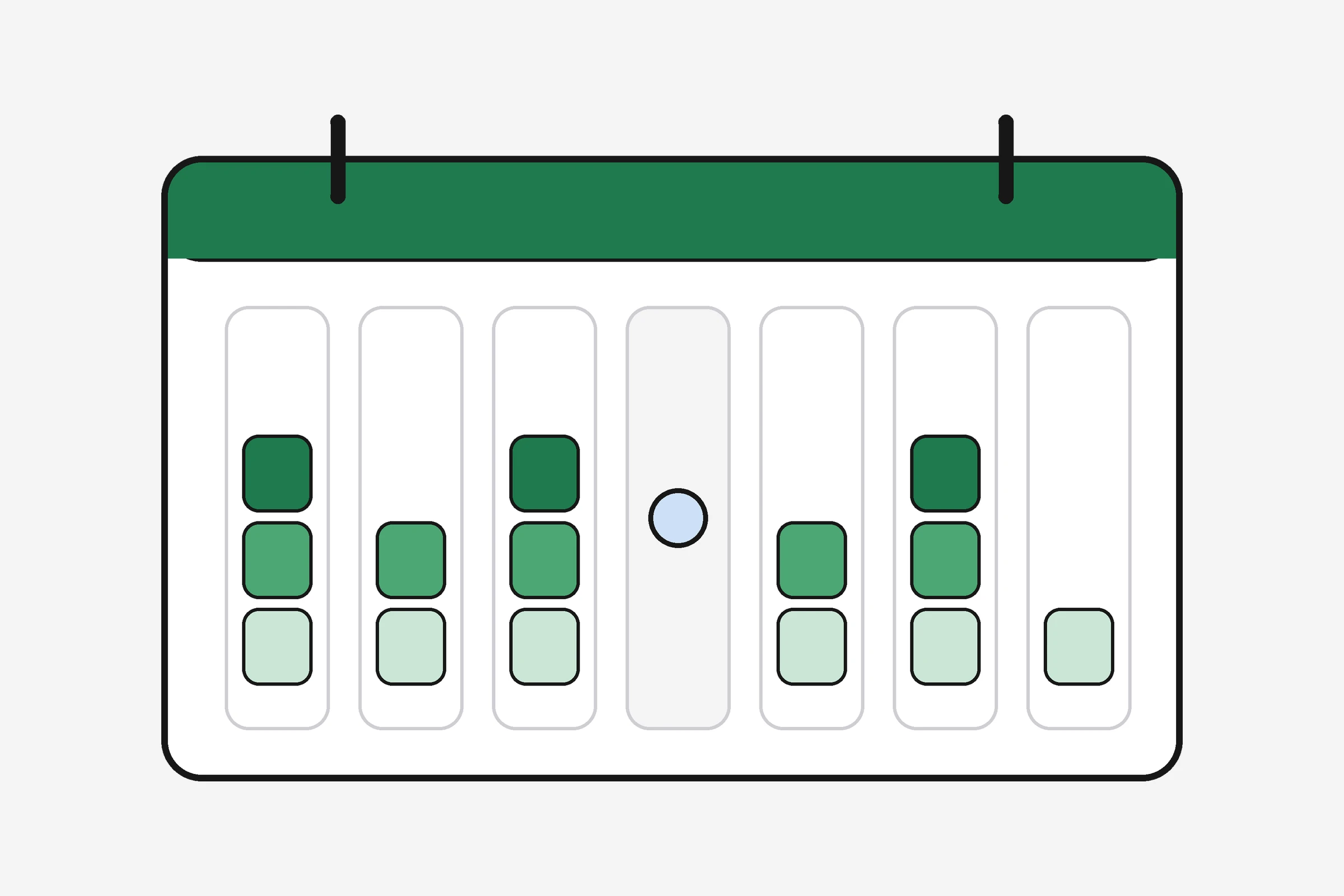
If you read our guide on sleep debt and weekends, you might wonder whether sleeping in fixes the problem. Catch-up sleep can help alertness in some short studies, but irregular timing still carries its own signal in cohort work. A practical merge: allow modest extra sleep after a hard block—not a three-hour schedule reset—and return to the same wake anchor within one day. That keeps weekly volume for training while shrinking the variability this paper measured.
When should you see a doctor?
Contact urgent care or emergency services for chest pain or pressure, sudden weakness, face drooping, speech trouble, one-sided numbness, or the worst headache of your life—stroke and heart attack red flags, not wearable anxiety.
Book a routine visit if you have sustained high blood pressure on home cuffs, palpitations with dizziness, snoring with gasping, or weeks of insomnia despite a stable schedule. Sleep efficiency below 85% most nights with daytime sleepiness also deserves clinical assessment.
This is general training guidance, not medical advice.
Related
- Sleep debt: can you catch up on weekends?
- What time should I go to bed? Hours, wake-up tables and training
- What time should I wake up? Sleep cycles and one steady alarm
- Normal resting heart rate: what is normal and what changes it
- How much deep sleep do you need?
- Sleep and recovery tracking
Sources
- Nguyen MTT et al. Sleep and Cardiometabolic Disease: A Wearable–Electronic Health Record Study in the US All of Us Research Program. Circ Population Health Outcomes 2026
- Windred DP et al. Sleep regularity is a stronger predictor of mortality risk than sleep duration: a prospective cohort study in 60,977 UK adults. Sleep 2024
- Chaput JP et al. Sleep timing, sleep consistency, and health in adults: a systematic review. Appl Physiol Nutr Metab 2020
- American Heart Association. Life's Essential 8: How to Get Healthy Sleep Fact Sheet (updated resource)
Terms in this post
revns publishes training and nutrition guidance, not medical advice. See a clinician for symptoms, injury or a medical condition. Accurate as of November 24, 2026.